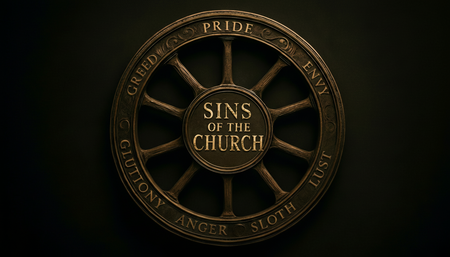
Today we turn to the sin of greed. Most people know that greed is among the seven deadly sins, but I think most view greed as a lesser sin than the others. Why is this so? I think this happens because most limit the definition of greed by thinking greed is all about wanting more money. But, while greed is certainly not less than that, it is far more than that. I believe greed is the excessive or inordinate desire to acquire all kinds of earthly gain at the expense of others. There is an old word that was often used to describe those who are greedy, the word avarice.[1] This word carries with it the idea of injury. Avarice in one’s heart will bring one personal benefit, but their benefit comes about by doing harm to others.
I think we know greed well. This world is constantly screaming greed at us. From ads to billboards to social media, every day we see new shiny things we could buy, and from seeing them new desires and cravings arise in us for these very things, even though beforehand we didn’t know they existed and didn’t feel that we needed them! But now upon seeing them we can’t imagine living life without them!
Greed is, therefore, harmful to ourselves and to others in myriads of ways. But, while the vice of greed is before us, so too is its corresponding virtue, generosity. These two rise and fall like scales on a balance. Greed injures others to benefit ourselves, while generosity benefits others and ourselves. All of this and more is what’s in view for us today.
To teach us on this, we turn to Jesus, in Matthew 6:19-21. In this small passage Jesus challenges our deepest assumptions about wealth, security, and the desires of our hearts. He’s calling us to consider not just what we treasure, but where we place our treasure, for in that choice lies the direction of our lives. As we unpack these words, we’ll explore three realities: the dangerous grip of greed, embracing eternal riches, and lastly, how we can cultivate a generous heart in this greedy world.
The Dangerous Grip of Greed (v19)
“Do not lay up for yourselves treasures on earth, where moth and rust destroy and where thieves break in and steal…”
Right away in these first few verses the negative and positive call is clear. The negative pursuit to avoid is laying up for ourselves treasures on earth, while the positive pursuit to pursue is laying up for ourselves treasures in heaven. Both of these pursuits are all about acquisition. See that? Jesus only puts two options before us. We will either live to store up earthly treasure or heavenly treasure. So in truth we are all of us treasure hunters, acquirers, going about life amassing possessions of various kinds. But what these possessions are and what they do to us and others in this life is of eternal importance.
Earthly treasures are, well, earthly. They are fleeting, temporary, short lived. We cannot take earthly treasures beyond the grave but must part with them on death. So earthly treasure, as its being used in this passage, means far more than money. Earthly treasures can be riches and wealth and gadgets and gizmos, but it can also be family, career, education, ambitions, goals, hopes, dreams, culture, country, personal standards, preferences, and the like. Jesus calls them treasures because we are prone to grab hold of them in a deep way, form an identity around them, find worth in them, and build a life on them. Whether these things are good or evil in themselves, they become tragic things for us when we see them as treasure. Why? Because if they’re sinful things they’ll deceive and destroy us, and if they’re good things we make ultimate they’ll disappoint and devastate us. They are after all, earthly.
This is the whole point of v19. Here Jesus warns us against living greedily, because earthly treasures can all be lost. This is why He brings up moth, and rust, and thieves. We get the gist of this, but this language would’ve been a bit easier to immediately understand for Jesus’ first century audience. Back then the practice of banking was still developing, and there weren’t air-conditioned storage units on every corner to safely store stuff in like today, so people commonly kept their stuff at home or at some other place they thought safe. But keeping stuff like this exposed their stuff to danger.
Jesus first mentions moth, meaning the bug, and meaning what the moth was viewed as in this culture, a symbol of destruction.[2] Literally speaking, moth and vermin of all kinds would often get into small spaces and ruin and destroy whatever they found. Symbolically, the imagery of a moth eating something up was used in Job and Isaiah to refer to destruction and judgment, which is the true end of earthly treasures. Jesus then mentions rust, meaning the corroding or spoiling of a thing over time. James no doubt has this very passage in mind in his own letter, when he writes in James 5:1-2, “Come now, you rich, weep and howl for the miseries that are coming upon you. Your riches have rotted and your garments are moth eaten.”
So the point is simple and clear: by moth and rust many earthly treasures are eaten up. And if we’re not yet convinced, after these two, Jesus adds a third way earthly treasures can be destroyed, thieves. Yes moth and rust will eat away at earthly treasures, but sometimes before that can happen thieves could break in and steal away what is dear to us. All in all, when it comes to earthly treasures Jesus wants us to know that they’re always in danger and very easily lost, so, greedily living to store them up is the essence of foolishness.
J.C. Ryle, in his book Practical Religion, mentions three devastating realities about being greedy for riches.[3]
First, Ryle says greed for riches is dangerous. It tends to have a hardening effect on the soul. It chills and freezes warm affections to Christ. It petrifies our inward man, and closes the eye of faith, causing us to forget God. For money Achan brought defeat to the armies of Israel and death to himself and his family. For money Balaam sinned against the truth he knew and cursed God’s people. For money Ananias and Saphira became infamous liars in the early church and lost their lives. For money Judas sold out the Lord. Greed for riches is dangerous.
Second, Ryle says greed for riches is unsatisfying. Sure riches might take away some cares and burdens, but be sure that riches add just as many cares and burdens too. There is trouble in the getting of it, anxiety in the keeping of it, temptations in the use of it, confusion in the disposing of it, guilt in the abuse of it, and sorrow in the losing of it. Greed for riches is unsatisfying.
Third, Ryle says greed for riches is ensnaring. Riches seem desirable at a distance, but they so often prove to be little more than poison in the hand. No one can tell what the effect of great money would do to one’s soul, and generally it is the prideful heart that boasts that riches would make him better.
Therefore Church, the more wealth you have the more you must take heed of your soul, a double guard for double the income. This all shows us the dangerous grip of greed. What do we do in response?
Embracing Eternal Riches (v20-21)
“…but lay up for yourselves treasures in heaven, where neither moth nor rust destroys and where thieves do not break in and steal. For where your treasure is, there your heart will be also.”
Standing against all of this is v20 and the pursuit of heavenly treasure. This is as glorious as earthly treasure was horrid. The one defining quality about heavenly treasures is just that, it’s heavenly. It lasts forever, it endures, it’s eternal. But, what is heavenly treasure referring to? I think it’s everything heavenly we enjoy in this life as well as everything we can take with us beyond the grave.[4] It’s all the spiritual blessings we’ve acquired as well as all the spiritual realities given to us here in this life, that we’ll enjoy in the life to come. Everything from forgiveness of sins, redemption, the new birth, eternal life, godliness, maturity, sanctification, to entering into the Master’s joy and the Kingdom He has prepared for us from the foundation of the world.[5] Jesus calls these things treasures because that’s what they are. Treasures to the soul, treasures that we will enjoy for all eternity, treasures first given to us in the gospel, and treasures that grown larger to us as we grow in Christ. God would be deeply pleased and honored if we held onto these treasures as tightly as we can, creating our identity around them, finding worth in them, and building our lives on them. They are after all, heavenly.
This is the whole point of v20. Here Jesus tells us the glory of heavenly treasures is that they’ll never be lost, because moth, rust, and thieves can never get at them. The common sources of destruction and deterioration can’t touch them, because they’re bound up with the Lord who will never deteriorate nor be destroyed.
Jesus summarizes all this nicely in v21, “For where your treasure is, there your heart will be also.”
Heart in this verse isn’t referring to the physical organ but rather to the central hub of our soul. The place from which all our affections and actions flow. Jesus means here that the treasures we choose to embrace display our hearts deepest reality. Or to use the words of this passage, what we choose to store up shows what our values and priorities are deep down.[6] So do not be surprised, the one who piles up earthly treasures will find his or her heart attached most deeply and most centrally to earthly concerns. But, the one who piles up heavenly treasures will find his or her heart attached most deeply and most centrally to heavenly concerns.[7]
Church, do you see the kindness of Jesus to us in this? Here He’s plainly telling us how to live wisely as well as how and why we should not waste our lives in greed and avarice. And He’s clear, telling us that our lives will be wasted if we spend them to accumulate earthly treasures, while our lives will be spent well if we spend them to accumulate heavenly treasures.
People say you shouldn’t put all your eggs in one basket, and I get that, and it makes great sense in certain areas of life. But in this regard, Church, all our eggs ought to be placed in the basket of heavenly treasure. Don’t let your lives and happiness and joy and identity and well-being of soul depend on something that you can lose. Earthly treasures all come to an end, heavenly treasures last forever.
So Church, tether yourself to Christ, and all that is to be had and enjoyed in Him, and you will have a very full life. So full that you can be generous with others. That’s really the point of this isn’t it? Yes we need to see the vice of greed in its ugliness but we need to embrace and learn how to grow in the virtue of generosity.
Cultivating Generous Hearts
How do we grow in generosity? Three ways.[8]
First, give gladly. 2 Cor. 9:7 says, “Each one must give as he has decided in his heart, not reluctantly or under compulsion, for God loves a cheerful giver.” How do we gain a glad cheerfulness about our giving? We remember how gladly God gave to us in the gospel and how gladly He still gives to us in the gospel. John 3:16 says, “For God so loved the world that He gave…His only Son, that whoever believes in Him would not perish but have eternal life.” Remembering this stirs gratitude within us, and gratitude does a great deal toward helping us be cheerful givers.
Second, give consistently. In both the Old and New Testaments we see clearly that when God’s people gathered for worship they took up an offering, or a tithe. In the Old Testament there was a prescribed 10% amount but in the New Testament we are free to determine that number for ourselves. So, God’s people have always been a people who have given back to God before giving to anything else. This consistency over the ages is a good thing, and Church, there’s no reason the pattern should stop with us. Just as the consistent effort to be up and moving keeps our bodies healthy and active, so too the consistent habit of tithing does much to keep our souls free from the grip of greed and avarice.
Finally, give sacrificially. I just said that in the OT there was a prescribed 10% amount the people brought with them for their tithes, and that this prescription isn’t there in the NT, that we are free to determine the amount we want to give. Some Christians learn this and respond to it by giving less than 10% believing they are doing a good thing. I would disagree. The model for giving from OT to NT isn’t a move from demanding to less demanding, but from demanding to even more demanding. Why do I say this? Because the model we look to guide our giving is Christ. He gave all for us, as He died in our place, as our substitute, on the cross. Paul urges us with this in 2 Cor. 8:9 when he says, “For you know the grace of our Lord Jesus Christ, that though He was rich, yet for your sake He became poor, so that you by His poverty might become rich.” If you’ve been stunned into faith by seeing the beauty of Christ, if you’ve been redeemed by the blood, if you’ve been saved by grace, you ought to be a generous person. That’s just what the gospel does in the heart.
The bottom line is this: if you giving doesn’t hurt, were not giving enough. Because Christ crucified for us is the model, our giving ought to hurt. I’d recommend you begin with the OT prescribed 10% amount and increasing that amount as you age and your income ideally increases with it.
Give gladly, consistently, and sacrificially. These things are true with all we call treasure in this life. So we give our earthly treasures and our heavenly treasures to aid and help those around us. And in so doing, we not only combat greed and avarice from rising in our hearts, but we also learn firsthand what it means when God says, “It is more blessed to give than to receive” (Acts 20:35).
Conclusion:
So Church, do you believe greed is deadly enough to be among the other deadly sins? Or do you believe greed is a small sin?
Perhaps I can put it like this to drive home the deadly peril of greed.
If you turn toward greed you’ll receive much benefit at the expense of others and your life will resemble Judas.
If you turn toward generosity you’ll receive much benefit along with others and your life will resemble Jesus.
May we grow from greed to generosity.
[1] Philip Graham Ryken, The Death of the Deadly Sins: Embracing the Virtues that Transform Lives, ed. Daniel M. Doriani (Phillipsburg, NJ: P&R, 2025) 58-59.
[2] Donald A. Hagner, Matthew 1-13 – WBC (Dallas, TX: Word Books, 1993) 157.
[3] J. C. Ryle, Practical Religion (Carlisle, PA: Banner of Truth, 2013) 308-309.
[4] Craig Blomberg, NAC – Matthew (Nashville, TN: Broadman, 1992) 123.
[5] France, The Gospel of Matthew, NICNT, 258.
[6] Morris, The Gospel According to Matthew, 153.
[7] Hagner, Matthew 1-13, 158.
[8] Ryken, The Death of the Deadly Sins, 68-70.