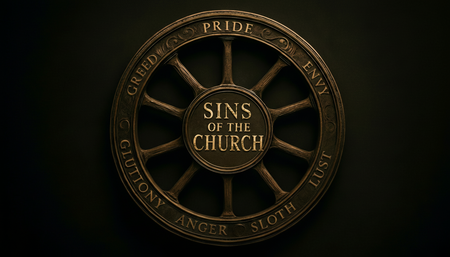
After seven weeks we have finally come to the last message in our new year sermon series. Perhaps I can begin by reminding you of why we began this series in the first place. Back on January 4 I said to you that we were taking time to study the sins of the church because we need to. We need to see our sin as it is, dreadful and disgusting, and from seeing such things our hope was to be made more eager to turn away from our sin toward Christ.
So church, has that happened?
We’ve examined pride, greed, anger, envy, sloth, gluttony, and lust. In our trek through these deadly sins have you been disgusted by your sin? Have you found fresh encouragement to fight and abandon these sins? Or has this just been a fun sermon series where we got to hear and focus on things rarely discussed in church?
On one hand we needed this series to help us combat modern culture, which normalizes the pursuit of sin and tempts us to believe that righteousness is strange. Virtue has fallen on hard times because the category of vice is now denied altogether. On the other hand, we needed this series to combat much within the modern church, which has followed popular culture. It is now normal to speak of various sins…not as grievous offenses against God which require repentance…but more as personal struggles or present woundedness from past trauma which require therapy.
In every generation we must uphold the doctrine of sin, to see it, to hate it, and to point us back to the wonder of God’s grace given in the gospel.
So today, as we draw this series to an end, I want to walk you through Psalm 1 and pose a question to you: who will you be? Will you be one who turns toward righteousness or wickedness?
I’ve divided Psalm 1 into three headings. See first…
Two People (v1-2)
“Blessed is the man who walks not in the counsel of the wicked, nor stands in the way of sinners, nor sits in the seat of scoffers; but his delight is in the law of the LORD, and on His law he meditates day and night.”
The first word of v1 sets the tone. “Blessed…” This word “Blessed” shows us that there’s a great fullness, abundance, and vastness to the blessing flowing from God to…to who? To the one who doesn’t do some things and does do other things. Notice that? Before describing what the righteous person does there’s a description of what the righteous person doesn’t do. The language here is all about how one walks, which of course, is a way of referring to course of one’s life.[1] So what does the righteous person not do?
First, the righteous person doesn’t walk in the counsel of wicked. They do not seek out or listen to the advice of the wicked, but it also they avoid the ways, habits, and lifestyles of the wicked. The righteous person does not live like the wicked.
Second, the righteous person doesn’t stand in the way of sinners. This means he has a select community because he chooses to live with and surround himself with the righteous and not with the wicked.
Third, the righteous person doesn’t sit in the seat of scoffers, meaning he doesn’t get comfortable or close with sinners. Sin is certainly present in his life, but it isn’t something he’s at peace with. To the righteous, sin is always a defect, a blemish, marring the godly life he’s seeking to live.
Notice the movement in these words. It goes from walking, to standing, to sitting. This movement begins small and grows to a lifestyle. In other words, sin can quickly grip us. It might begin with a brief moment of giving in to sin but quickly grows into more and more sinful patterns until those patterns become habits and those habits become lives built on the very thing God hates. This is the way of sin is it not? Sin is always a downhill path from bad to worse.[2] This is what the righteous avoids.
In v2 we see more. Here we find what the righteous does do. And it’s all about the Law of the Lord, or the instruction of the Lord. While the wicked is intimate with and settled into all that is sinful, the righteous is intimate with and settled into the Word of God. The righteous rejoices in this, his delight is in this, his happiness is in this, he feels blessed in this, he feels rich and abundant in this. And so he isn’t content to merely open the Word for just a moment but meditates on it day and night. Meaning, he lingers over it long enough so that he sees the Lord’s beauty and his heart warms.[3] In other words, meditating on the Word is the chief pursuit of his life because God is the chief joy of his life.
There is a great challenge here for us. What’s your relationship with the Bible? Do we read it? That’s good. Do you sit still over it long enough for your heart to go warm towards God? That’s better. Do we just give a few minutes a day, or do we study it? Is it our most familiar companion in life?[4] Many hear of this and think this kind of study is only for mature Christians, or for pastors. Church don’t buy it. The kind of deep and rich study of God’s Word in v1-2 is for Christians!
The difference between the righteous and the wicked in v1-2 is massive. The blessedness and happiness of v1 isn’t just about saying no to worldly things, it’s about saying no and then also saying yes to the best things and pursuing them with all our might! The best of all things belongs to God, and so to live a life in pursuit of Him is the best kind of life to live.
To further impress this upon us, Psalm 1 now gives us two images.
Two Images (v3-4)
“He is like a tree planted by streams of water that yields its fruit in its season, and its leaf does not wither. In all that he does, he prospers. The wicked are not so, but are like chaff that the wind drives away.”
Once again the righteous and the wicked are contrasted. The righteous man is likened to a tree and the wicked man is likened to chaff. These are opposite in nearly every way.
v3 begins with the image of a tree. This is what the righteous man is like. They are planted by God near streams of water. So well rooted and fed by that stream that in every season, in plenty and in lack, in lush growth and in dry barrenness, they are ever green and bearing fruit. Why is this tree so well planted and strong? Because of v1-2, the righteous is nourished by delighting in the law of the Lord. They delight in it and meditate on it day and night, and because of that their roots grow deep…so deep that even in winter their deep roots are not reached by the frost.
Have you ever asked, ‘Why a tree?’ Of all the images the Psalmist could use, why this one? Think back to the Garden. In Genesis 2 we learn there were trees in the garden. Adam and Eve were commanded to not eat from one tree, the tree of the knowledge of good and evil. This implies they had complete freedom to eat from any other tree in Garden as often as they so desired.
Trees were not only present in Eden, they were woven into the tapestries of the tabernacle (Ex. 25:31-39), and in Solomon’s temple, (1 Kings 6:18, 29, 32, 7:18), and were in all of Ezekiel’s visions of the future temple to come (Ezek. 31:8-9, 41:18-26, 47:12), and are in Revelation 22 in the new heavens and new earth.
So why trees in Psalm 1? Because it’s a consistent image of the righteous in all of Scripture. In Revelation we, perhaps, see the most Psalm 1 like language present. There the river of life is flowing out of the throne of God and the tree of life is growing and flourishing all down its banks growing ever green leaves that are for the healing of the nations. Question, are these literal trees? I’d say no. In Psalm 1 it isn’t a literal tree in view but the righteous described like a tree. So too, at the end as the river of life flows out from God nourishing the saints, it is those saints who are likened to be trees once again, deeply rooted along the banks with ever green gospel leaves that heal the nations.
Ultimately, it is Christ is the living water giving life to His people causing them to grow evergreen.
As wonderful as this is in Psalm 1:3, the next image in v4 is dreadful. The righteous are like the tree but the wicked are “…not so.” The language of chaff being easily blown away in the wind is used to describe the wicked. Job, Isaiah, and Hosea all employ this kind of language to depict the judgment of the wicked. None of the good and glorious things we’ve been lingering on that are attributed to the righteous will ever be true of the wicked. They are the opposite in character and in condition. Instead of being planted by God, firmly rooted, ever nourished, and ever green, they are like weeds, shallow and weightless; like a blemish on a healthy landscape. They are like chaff the wind easily drives away.
The image in view is a winnowing at a threshing floor, where corn that’s been gathered is sifted or tossed up to separate the good from the bad. The corn is then taken into barns and the useless chaff is blown away.[5] Meaning, while the wicked may seem vibrant in this life as they prosper in their worldliness, in the end they’ll be seen for what they are as the Lord bares all things and brings all men to account.
All of this is leading somewhere in Psalm 1. In v5-6 it all leads to the two ends each person is heading towards and will one day arrive at.
Two Ends (v5-6)
“Therefore the wicked will not stand in the judgment, nor sinners in the congregation of the righteous; for the LORD knows the way of the righteous, but the way of the wicked will perish.”
Here is one more contrast of the righteous and the wicked. While v1-4 primarily contrast the lives these two people lived, this last contrast has everything to do with the end each will experience. It’s as if the Psalmist is telling us, ‘Because all of this in v1-4 is true of the righteous and the wicked, do not be unaware of how all this will end.’[6]
The wicked, v5 says, will not be able to stand in the judgment. We know what this is.[7] To stand is to be stable, and unwavering. This is what the wicked won’t be. All their confidence, all their bravado, all their boasting, will end as they are exposed for what they are. It says they also won’t be able to join the congregation of the righteous. Throughout the history of the world the righteous have often been scattered abroad while the wicked have assembled against them. In the end that will be reversed when the Church universal is gathered once for all. In that gathering only be the sheep will be present, no goats; only be the wheat, no tares.[8] We might be all mixed together now, but in the end there will be a great separation.
Even if they could be present in this host, they wouldn’t like it and wouldn’t want to be there. Why? Heaven would be hell to those who hate Christ.[9] Also, the absence of sin in glory would be hell to those who made a home with sin here. But see the beauty if we turn this around. To those who’ve died to sin here, who’ve hated sin here: hated its power, hated its allure and presence…heaven will be all the greater due to sin’s absence, as we enter into the joy of our Master and praise Him for His victory forevermore.
This thought is developed further one last time in v6 as we see the final contrast in Psalm 1. “…for the LORD knows the way of the righteous, but the way of the wicked will perish.” Wait, doesn’t God know all things? Why does it say He only knows the way of the righteous? Doesn’t He also know the ways of the wicked? Of course He does. The word ‘know’ here in Hebrew doesn’t mean ‘knowledge of’ but ‘closeness with.’ This is the word used in Genesis 4:1 when Adam knew Eve and had a child. This is a word of intimacy, of affection, of great love. So yes the Lord knows all things, but He only knows (greatly loves) His people. In this sense He does not know the wicked. So standing against this picture of the Lord’s intimate dealings with His own in v5 is the destruction of the wicked in v6.
Conclusion:
Church, Psalm 1 is a fitting place to end because it forces us to ask, who will we be? Righteous or wicked? If you choose the way of the wicked and make room in your soul for sin, you’ll have quick thrills and instant gratification, but you’ll eventually whither up and die. If you choose the way of the righteous and make room in your soul for delight in the Lord, you’ll have deep joy and lasting satisfaction in the Lord, but it’ll take time.
That’s something of the point of Psalm 1. By using the image of a tree, Psalm 1 calls us to growth, yes, but remember…trees take time to grow. So too you can grow to be spiritually robust, but it won’t happen by a quick Google search or a few Bible studies, it takes time. You can’t see this growth day by day but can see it year by year.
So, here’s my challenge to you. For nearly two months we’ve examined the seven deadly vices and their corresponding virtues. And now we’ve seen the call and challenge of Psalm 1, to choose the way of the righteous over the way of the wicked. Church, take one year. Put your sins to the side and commit to be the righteous person of Psalm 1. You won’t see much change after a few days, a few weeks, or even a few months…but this time next year, you’ll be an entirely different person!
I know this hits many of you differently. Some of you here are fighters, you’re doing this already. I love that spirit. If that’s you take this sermon as your cue to keep going!
Others of you here are fighting and feeling like you’re losing. You’ve still got that fire within you and still want to fight, but it’s as if you know you can’t hold out much longer.
Still others of you are here and you’ve given up the fight because every time you have worked up the courage the fight you’ve been smacked in the face and fallen off the horse. Now, the last thing you want to do is get back up again.
Wherever you are…here’s the encouragement of Psalm 1.
Jesus is the point of Psalm 1. These words apply to Him in far greater ways than they actually apply to us. But the crazy thing about that is when you trust in Christ, are saved by Christ, and filled with the Spirit of Christ…in God’s eyes what is true of Jesus is now true of you.
Psalm 1 then leads us to Christ and shows us the kind of blessed life that characterizes all those who are in Christ.
[1] William S. Plumer, Psalms (Carlisle, Pennsylvania: Banner of Truth, 2016), 27.
[2] Matthew Henry, Commentary on the Whole Bible, vol. 3 (Hendrickson Publishers, 1991), 194.
[3] James Johnston, The Psalms: Rejoice, the Lord Is King, Vol. 1, ed. R. Kent Hughes, Preaching the Word Commentary (Wheaton, Illinois: Crossway, 2015), 27.
[4] Charles Spurgeon, Treasury of David – vol. 1 (Mclean, Virginia: MacDonald Publishing, reprint) 2.
[5] Derek Kidner, Psalms – TOTC (accessed via Accordance Bible software, 6.5.20) 67.
[6] Waltke and Houston, The Psalms as Christian Worship, 141.
[7] Plumer, Psalms, 31.
[8] Plumer, 31.
[9] Spurgeon, Treasury of David – vol. 1, 3.