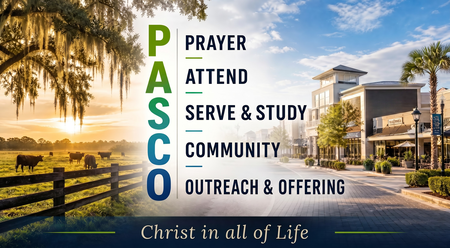
This morning, we kick off our new series this summer, Pasco.
This series is going to dive in each week to a different element of what we believe is essential in the Christian life, specifically, and all importantly, for the members here at Sunrise. Many of you have gone through a membership class here, if you are a member. You've gone through a class, and we've given you expectations and what we think of members. If you've been at one the last year and a half, Pasco has become a part of what we discuss. It's a lovely little acronym. Nope.
Nope. It's an acrostic. Sorry. We clarified that. That was the whole point. It's an acrostic.
It's an acrostic to help you be reminded of what it means to live out the faith. What are some of the things that we expect of members to do? What do we expect, ultimately, of Christians to do? These are the seven things ... I know, Pasco's five. That's why we made some fun pieces work together.
Two S's, two O's. It's not Pascoo. It's still Pasco. This is what is before us. Over the summer, each of our elders are going to unpack a different one of these elements of the Christian faith to help us dive deeper into how the gospel shapes us and how we're called to live this out together. As we, as a body, live the gospel out week in and week out, these are the seven elements that we feel should be active and growing in your life.
Each week, we'll unpack it. Today, we'll start with the foundational one, prayer, because without prayer, the rest of them fall apart. Prayer is where we'll begin. Next week, Pastor Adam will unpack attend. Then we'll talk about serving, studying, community, outreach, and offering. All of these elements, as part of the Christian life.
We have a lovely little bookmark out in the foyer, if you'd like to grab that. It has all the weeks and what we're going to be, what the text, or not the text, but what the topic is each week, and a brief summary of what that is and how that affects you as a believer. Be sure. Grab one of those. It's very fun. You can put it in your Bible.
You can keep it with you throughout the summer, or beyond the summer, because these are, as we said, these are the marks of what we feel is an essential part of a believer. These are just helpful to keep with you beyond the summer of 26. We're going to keep it more and more in our vernacular. Again, Pasco is what is before us. With that, we begin today with the foundational letter. That is P.
Intro:
The P in Pasco is prayer. As we begin, what is prayer? Maybe a common question you may ask yourself. What is prayer? If I ask everyone in this room, you may have a different definition. Some of them may have overlaps.
Some may be similar. Some may be wildly different. I want to begin with five definitions that we find in roughly reformed church history. Two confessions, or two catechisms, and three quotes. We begin first with the Westminster Shorter, so my Presbyterian friends out there can enjoy this one a bit. Our Presbyterians, with our Shorter Catechism, what you train in the gospel, how you train your children is often most common.
They define prayer as an offering up of our desires unto God for things agreeable to his will in the name of Christ with confession of sin and thankful acknowledgement of his mercies. Solid definition. Easy to train and teach children. Heidelberg Catechism, again, each Lord's Day they have a confession of what you would recite when it comes to prayer. This is what they give for the recitation. Prayer is the chief part of the gratitude which God requires of us, as well as the means by which God gives us grace and spirit.
Those are two catechisms, again, ways to train people, so things that you would memorize and recite. Historical reformed views. The three reformed definitions, so first John Knox, Father of Presbyterianism, I know, I'm the Baptist quoting Presbyterians, I'm sorry. Father of Presbyterianism in Scotland, so Scottish reformer defined prayer as an earnest and familial talking with God to whom we declare our miseries, whose support helps we implore and desire in our adversities, and whom we laud and praise for our benefits received. Beautiful definition. Calvin, simple, to the point, is the chief exercise of faith by which we daily receive God's benefits, straight to the point.
Then Tim Keller, a more recent one, prayer is continuing a conversation that God has started through his word and his grace, which eventually becomes a full encounter with him. So again, Keller highlighting prayer as an outflow of our receiving of God's word and the grace of salvation that then leads us to respond. So each of these are different definitions found within the reformed history over the last 500 years, helping us to unpack and think through what is prayer. So they highlight different things. So some have very lofty, it's the knowledge and celebration of God. Some is the pouring out of our hearts and some just it's the chief end.
Like there's just very different elements that people highlight and focus on. All of which are good definitions. They're good places to help us think through. But ultimately each and every one of them have the same theme which it is communicating with God. It is that communion with God. It is a relational aspect of us to God.
Each of them have ultimately that heart of us going to God and communicating with Him. And so when we think about this, prayer is one of the single most essential and beginning points of all of Christian life. It's how faith begins. God transforms us, saves us, leads us to repentance and faith which is prayer. Faith begins, okay, through the work of the Holy Spirit that then leads us to repent and believe. We begin the faith in prayer.
Communicating with God. His work leads us to that. So communication with God is an active and continual part of the Christian faith. Yet for many they feel dissatisfied with their prayer life. So if I was to ask everyone in this room how many of you feel satisfied with your prayer life? It's a rhetorical question so we don't have to get awkward if we don't want to.
So Crossway did a study back in the day, okay, about seven years ago. A massive study on prayer in the Evangelical Church. Okay, they surveyed over 14,000 Christians and asked how satisfied are you with your prayer life? 98% said they are dissatisfied. 98% of believers in the survey were dissatisfied with their prayer life. Of ministers that they surveyed, 84% are very dissatisfied with their prayer life.
72% of those saying that they need and want and yearn to invest more time and consistent personal prayer outside of the pulpit, which is an interesting time. Again, these are statistics. Take them as they will. Statistics are what they are. But I think most of us in this room can probably agree to some extent a feeling of dissatisfaction with your prayer life. I've had many conversations this week on this very topic or in the last few weeks.
Several books that I've been reading on prayer highlight this same thing. And of that 98%, going back to that that were dissatisfied with the prayer, 40% of those do say they pray every single day, at least once a day. And yet still there's a dissatisfaction. There's something that they feel they need more of. And what's interesting here is that does highlight for us the reality that dissatisfaction also isn't a bad thing. And that's what I'm hoping to unpack a little bit today, is that in dissatisfaction we should therefore be encouraged to pursue God all the more.
That the purpose of the dissatisfaction is to push us more towards God and not away from God. If your dissatisfaction in your prayer life leads you to not pray, then you are misusing this gift. We should see it as an opportunity to be reminded of the grace that's been given to us to pull us closer to God. And so we'll cover this a little bit as we get to the sermon because people have different levels of how they feel dissatisfaction works. But ultimately through a series of conversations there's so many different ways that we could have gone with the topic of prayer. We could do a whole sermon series on prayer.
There is so much in the Bible on this topic. Beginning to end, that's why I gave you three texts because I'm going to kind of put together an argument here for us that I think is important for us in beginning and unpacking this series. I want to highlight three key things about prayer. The first being the necessity of prayer. The need for us to be people of prayer. And then from that necessity then becomes the posture or the heart then of prayer.
So we agree we need to pray, then how do we pray? What does that look like? Then from that what do we do when we can't pray? So we're talking about the spirit of prayer. These three elements I think help build a foundation for everything that we will unpack over the following seven weeks. Because all of this again flows from the gospel.
This is the heart of those who have been redeemed. You've experienced the saving work of Christ. If you've been transformed by his work, the overflow was repentance, which is prayer. And then the continual overflow of that gospel should be prayer. And so I want to unpack that for us today. And so we begin first, as I said, with the necessity of prayer.
- The Necessity of Prayer
This is in 1 Thessalonians 5. So beginning in verse 16 through 18 it says, Christ Jesus. So as Paul is giving here his final instructions before or to the Thessalonian church, he gives them this encouragement that the will of God for them is to rejoice always, pray without ceasing, and to give thanks in all circumstances. He's giving them this charge to think through. This is what the will of God is. That's a bar.
God's will for you is to pray continually without ceasing. You can feel how discontent in this can really quickly pop in. I'm clearly failing at the will of God, right? You feel a little bit when you hear that. And that's kind of what he's pushing them to think deep, to dive deeper into their relationship with God. And all of these things are gonna flow from it.
So again, as I said, as you pray, you should pray continually in each of these things. As you join together in Sunday worship, prayer should fuel your worship. Okay, prayer should fuel the songs that you sing. Okay, it should fuel the joining with others in prayer. It should fuel the service that you do. If you serve in ministries, it should fuel that.
Do you pray before you serve in ministries? Do you pray while you're serving? So those who are at Heather, or not Heather Hill, sorry, Volunteer Way yesterday, was prayer an aspect of that moment? Was prayer a part of what you were doing? Or were you just going through the act? At Heather Hill, is prayer an aspect?
When serving in the church, is prayer an aspect of, not that we all sit down and pray, but is prayer a part and a posture of your heart in those ministries? So it's an encouragement that all of these things flow through this continual state of prayer. We must be people that are in prayer because prayer leads us into fellowship with God. It's how we communicate to God. And so it's a key aspect of the whole Christian life because it's the key to a good relationship. So everyone in here who's married, or has been married, or has ever dated someone, or just had a friendship at some point, probably knows foundationally, communication is key.
I think everyone who's about to get married and they go into the membership, or their premarital class, and communication will sustain your marriage. You can go, ha ha, we communicate great. And then six months in, you're like, we communicate horribly. Um, don't realize until it starts to break down. But the communication is key. It's not just a slogan, it's a reality though.
Communication is how you build life together. It's how you build intimacy. It's how you lay out your burdens for one another. And so there is no substance in a relationship if there's not communication in the relationship. So I use the illustration when my wife and I have been married now for six years. And so what would our marriage be like?
What would our relationship be like if all I did was I read her favorite books? I just read her favorite books all the time. Good books, great books, read her books. Check her, make sure her online, just check the updates. See how the Facebook's going. She's having a good day, that's good.
I'm glad, I'm glad things are going good. Maybe I'll clean up the house. Make things all nice and pretty around town, make it nice. Maybe I'll just hang out with her on the couch. We'll just sit near each other, it's good. It's good spending good time together, just being present.
Maybe, you know, I'll buy her some nice gifts, put it on the table, a nice bouquet of roses. Maybe I'll hang out with her friends. Really like her friends, her friends are cool, most of them. So you hang out with them. No, they are, they actually are great people. They're all in here right now.
So not only, I'm just saying, not only, they're great. So that picture, so then you spend time with them. This is great, I really get to know them. I get to experience her through them. What relationship is this? Is this a good, healthy, building relationship?
Or am I spending any actual value with her? Because if I never actually talk to her, some of the people in here can get a weird high school vibe here for this. You're not in an actual relationship, you're just stalking people. It's creepy, you should stop it. Your imaginary relationships. But this is ultimately, in some ways, what we do with God.
It can very easily become the like, well, I go to church. I was in church today, I was with all of God's friends. I read the Bible, he likes the Bible. I read it, it's got good words. He says cool things in there. I really like his posts, he's really teaching me things.
We have this, I did things, I served in the nursery, I went to Volunteer Way, I help, I do all these things. But if there is no prayer, where is the relationship aspect of this between you and God? In the text, the scripture continually calls us to pray. Prayer is a continual reminder from beginning to end. We go back to Genesis. It begins with God in the garden with Adam and Eve.
There is communion, there is communication that exists between man and God. We'll unpack the other side when we come to study. We'll talk about God speaking to us through his word, but we're today focusing on. speaking to God. And so this becomes the admonition. Is this a part of our life?
Are we growing in our relationship and intimacy with God through prayer? And if not, if this is something you struggle with and you're dissatisfied with, I will say, welcome to the party. 98% of people feel this way. Some will say it should be a hundred, but we will digress for now. But this picture becomes that we know that we need to grow in that. Because the second you become, as I said, content in it, as you feel satisfied in it, is probably when you begin to fall away from it.
Again, the same thing with relationship. The second you think that you're communicating well and everything's perfect, you've consented, then just, we achieved it. And then very quickly slide back into exactly the way things were before because you stopped paying attention to it. Because you achieved it, so now it became less of a burden. So scripture, can pray without, continually be in prayer. Just, that is, that is a bar.
It's a very high bar and it's calling us to the grace to pursue Him, to continually be in relationship with Him. It's that, unfortunately, we are naturally selfish people. Sin naturally leads us to be selfish. We are self-obsessed. And so even sometimes on prayer, prayer just becomes about us. And just telling God about how great we are, all the things we want, and we don't even acknowledge Him in it.
Also, sin, in our self-obsessed nature, can also tell you, you've got this. Don't worry God with that. He's too busy for those things. You've got it. It's not that big a deal because we can handle some things. God doesn't need to handle everything.
I've got something. So there becomes, even in that, there's a bit of an arrogance that we don't even naturally realize. It's a humble arrogance. One of the things you learn a lot about is humbleness can actually be pride, if you think about in the wrong way. So it's like, I've got it. And ultimately you're saying because God can't.
Whether you realize it or not, or you're wanting to get some type of glory for yourself out of, I accomplished it without God. When ultimately there's nothing that we accomplish without God, even if you think you've done it, it's only God's mercy and grace that cause you to accomplish such things for His will and glory. But we don't think that way. We're seeking our own ends. And so we don't want to make this a habit. We want to make prayer a habit, not ourselves.
Okay. That should be our goal. So do we continually push in and commune with God through it all? And it requires time, development, growth. And it requires discipline. Prayer is not a laissez-faire aspect.
It requires discipline. It requires being purposeful. And we're gonna unpack this in a minute. Purposeful. Intentional. Seeking to honor God and grow in this.
And it requires time. Can you have an active, vibrant relationship with someone you barely talk to? And so it reminds me of one of my closest friends. I'll still say he's one of my closest friends because we've been buddies since we were... I was 14 and he was 15. We grew up in youth group together.
That's right. Good old church youth group days. Playing some 007 on a N64 because we're old. Because that's not a lie either. So that's just the picture of we've known each other a long time. And throughout high school and college we probably spent every single day together.
So there was a group of five of us. Every single day we probably spent together. Especially in college. High school, a little bit different. But at college, every day we hung out. We knew everything about each other.
Ins, outs. People may have said we're a little codependent. I don't know. It's college. But that was just we lived life together. We spent time together.
We prayed together. We did work together. We just spent all... If you asked us anything about someone in our group, we knew everything. We knew exactly what they were struggling with and knew what their hang-ups were. We knew everything.
Because we spent that much time together. Now fast forward. He went off to... I went to college or I went to seminary in North Carolina. He went up to firefighting Academy out in Fairfax, Virginia because he wanted to be fancy that way. We grew up.
We became adults. Went in different directions. We speak twice a year. Darn bad. He was in my wedding. I did his wedding.
We've known each other for a long time. Like I said, we talked twice a year. Probably four or five hours. Long conversations. Cover everything that's happened that year. Mostly the highlights.
And then we keep track of each other online. That's how we know most of what happens in each other's lives. And then we talk about some of the big stuff. And if anything major comes up, we usually talk then. But most of the time it's just highlights. It's house things.
Oh you're doing great. You guys are doing... That's so great. When are you retiring? Because you get the fancy firefighter life and retiring at like 50. Congratulations.
But it's just like what are your plans? What are your guys' next plans? Oh you guys are gonna... Oh that's so cool. What we're doing here. It just becomes very quick.
Four hours quick. But you're summarizing in six months. But it goes... We pick up kind of... where we left off, but also where you left off was not that much different from two years before, which isn't that much different than three. A lot of life has actually happened in that time period.
Many of you who have high school, college friends who you do this with understand this. You're not really unpacking most of what's going on in life. You're giving highlights, you just, because it's like, oh, it's great to talk to you, that's awesome, I'm glad we're still connected. But what's really going on, like, oh, we're really struggling with this, this, and this, I'm having a hard time at work with like, those aren't things that come up, we ain't got time for that. I'm not gonna talk to you for six months. It tends to become very surface level.
Because familiarity over time, and again, it's 20 years, time changes. And even again, when we first moved away, we talked a lot more often, and then life changes. And then you get 20 years down the road, and it's two times a year. Like, it's just the natural ebb and flow. But unfortunately, the familiarity that you still hold on to as if we're still the same people we were when we were 18. We're very different people than when we were 18.
But there are times that if we're together, it feels like we're 18. It's sad. I think many of you also identify when you hang out with your high school, college friends that way, if you do that. It's, haven't quite grown up sometimes. That's an aside, I'm sorry. So as we get through it, this becomes this picture, though, of sometimes, even in our own relationship, with those in this room, maybe you've walked with God for a long time, and you first came to faith, and you had that vibrant relationship.
You had that vibrant prayer. You were always praying. You experienced the grace of God. You started down this path, and you needed God. You felt that need continually. Oh, he saved me.
Oh, let me dive into his word. Let me read what he said. Let me respond to what he said. Like, that overflowing daily, and then over time, they said you got comfortable. Becomes a little less. Life becomes a little more ”important.” Like, that is, that becomes the picture of other things block out more and more of your time. That God becomes more and more an afterthought, and that relationship begins to change, becomes less important to you. We lose sight of the call to continually be in communion with God, to continually be people of prayer. And so, Thessalonians, Paul gives us that admonition not to forget this is the will of God for you, is to pray always, to continue in prayer. Is prayer a daily, continual aspect of your life?
And I think we can all agree that it should be. Okay, I think we can all agree we should be people of prayer. But then, what do we do? So what does it look like? Okay, let's say yes, we need to pray more. Okay, so how do we pray?
- The Posture of Prayer
Okay, and then Matthew is where we turn, as Jesus then, in his Sermon on the Mount, gives the disciples what it means to pray. So we have this picture of what then does it mean to pray. And so, as Jesus has been unpacking all these different truths, he's been giving them this understanding. Again, when we see Luke's telling of this in a different way, you have that picture of the disciples asking him how we should pray. In Luke, or in Matthew's account here on the Sermon on the Mount, we have this sermon telling of how we should pray. And so, begin in verse five, it says, and when you pray, not if you pray, when you pray, okay, in this admonition to those who are listening, the disciples and all the crowd here at the Sermon on the Mount, when you pray, your natural state of being, continually, must not be like the hypocrites, for they love to stand and pray in the synagogues and at the street corners that they may be seen by others.
Truly, I say to you, they have received their reward, but when you pray, go into your room, shut the door, and pray to your Father who is in secret. Your Father who sees in secret will reward you. And when you pray, do not heap up empty phrases as the Gentiles do, for they think they will be heard for their many words. Do not be like them, for your Father knows what you need before you ask. And so, as we see here, we see this posture of prayer, this heart of prayer that Jesus gives to those, the disciples and those here on the Sermon on the Mount, which ultimately is answering, how then do we pray? How are we supposed to pray?
Big question with a simple answer. So he highlights it with two heart postures, if you will, two mental points of going to God. And the first is that prayer isn't about you. Okay, so prayer isn't about making much about you. Okay, so he begins with the Pharisees and the hypocrites, those who pray with lofty words to be seen by others. Okay, as a minister, it is very awkward sometimes to pray in public, because then people will thank you and tell you how great it was, and then it's just awkward and creepy.
It just is. I prayed once for a Thanksgiving meal and people applauded and it was a weird moment for everyone. They were not Christians just so we're aware it was a moment But it's like that's not what that's supposed to be about We're missing the heart But if that is the point if the point is just so that people will talk about man that guy can pray It always feels weird when people will talk about like, oh, I remember listening to blah blah he could pray like no one else and it's like But then can he pray like Because do we really know their hearts and prayers of the Saints or do we just know how eloquently we can speak up here? So we should not judge people's prayer lives based on what we can do in public Nor should your prayer life be based on what you can do in public so how great I can pray at a small group or how much people tell me they enjoy my prayers that Defeats what God is talking about. It's where is your heart when it comes in prayer? Does it come in a spirit of humility?
Is it about being with the Lord or is it about being showy? Okay is about making much of your need for God or for how much God loves you So these become our heart. So when we come to God, it's not about us Okay, this is the same idea. You love the Good Hope Award Show seasons We get all the great music and movie awards and everyone begins with I'd like to thank my Lord and Savior Jesus Christ Because without him I could not have accomplished all this thing And now for the next 30 seconds before they walk me out I'm gonna talk about great I am and how amazing I am It's like yeah, but I gave Jesus the nod at the beginning. So the rest is fine Like that's kind of the way it's treated. And this is what that is not an accurate reflection of Transformation by the gospel leading to humility and recognizing God as the source of all these things God is the one who has changed you who has transformed you who has given you the life that you have and so when we pray it is a Relationship between us to him and so he uses the idea of pray in secret Okay, go into your room and close the door Okay, he's not literally meaning that you can only pray in a closet in the dark The picture here is that we are praying in a secret sense.
We're not praying for other people For the sight of other people you should be praying for other people But that picture is that you're not okay making much of how great you are But rather you're humbling yourself before God in prayer to him alone We aren't here for the crowd. The second thing is to be purposeful in prayer so we come to God in a humility, okay a heart posture of humility not to be made much of and also we come with Purpose. Okay, as it says don't heap up empty phrases as the Gentiles do for they think they'll be heard for their many words The picture here is just rambling hoping to get across that God will be like, that's cool They talked to me for five seconds today didn't really say anything but just ramble away or just empty Recitation. Okay, we love some good written prayers. I'm not against we're in prayers We just did one from one the Gibson liturgies highly highly recommend some pre-written Devotional prayer life Valley of Vision fantastic every moment. Holy we just gave Aiden one of the copies They have a whole series their prayers for just everyday life again the Gibson liturgies There are different ones for different seasons entire worships for a family worship Phenomenal works, but if all they exist to do is to give you information That is not very helpful to your spiritual life Or if they're just there for you to blandly and mindlessly recite them as if you're praying you again have nullified The purpose of them there to draw us into God that we read and understand and join in these prayers of old That it's not mindless recitation that it's purposeful Just as when you sing the Psalms the Psalms are prayers When you read them, are you just reading them for pure knowledge when you recite them?
Are you just reciting them because you're supposed to recite them or do you connect and actually pray the words that are on the page? You this is literally what I want to tell God in this moment Very much can think of it Sometimes you got to write out Like you got a big thing to tell your spouse or a friend or a little you write it down So you make sure you say exactly what you want to say Especially if you have a tendency to go off base like I do you want to be intentional in this moment So you're gonna write it down. So it's very intentional because you're gonna say 90 other things. You don't want to say That's what a pre-written prayer helps do helps focus you Okay, that is one way to be purposeful, but you can also be purposeful in long wandering prayers You can wander around if you're a wandering person. Not everyone is we live in Florida. We got lots of nature some people become wanderers or our commuters that enjoy a good hour on the road opportunities to take the most use of God's time and pray and Using that time to be purposeful of what things come to your mind while you're driving.
What are the things the Lord is instructing? What are things that just you think about? Okay, sometime that's listening music. And what does the Lord put on your heart and pray and respond and think about just thinking? Through your week, there are different things you can pray about work, family, friends, your small group members, your church families. We are called to pray.
Again, one of the expectations in prayer is that we're praying for one another, okay, that we're using the time that God has given us wisely to commune with him. One of the great things about being in nature and praying and walking, if that's your thing, is just even celebrating all that God does around you. You just see his work even in nature and are astounded by how much he cares for even the simplest of things. Again, Jesus uses all these illustrations. How can you talk about the love God has for a sparrow if you've never seen his love for a sparrow? If you don't see these things, you don't appreciate the vastness of God's work.
Same if you're not in each other's lives, it's hard to pray and celebrate God's vast work if we're not invested in one another. So this becomes this call to pray well, and so I said it looks different for everyone. Some it is. 4 a.m., you wake up, it's the first thing you do, you pray. You may set the coffee timer, get it going, you pray. Others it's you have an hour in the afternoon drive and you pray.
You have all these different times, but you're purposeful and it's intentional. What am I praying for today? What am I thinking about? What are things God has laid in my heart that I need to express to him? And we intentionally then go to him with these things. Don't keep them inside yourself.
Don't keep them inside your head. Tell them to the Lord. Don't just use random babble. Be purposeful, be intentional so that we pray well and be honest and spend a good amount of time with the Lord as he has given you. So use the time he has given you wisely. And so we have these points.
So we are to pray without ceasing. We're to pray purposefully and humbly, seeking to make much of God. But there does come times in our lives we can be honest. It's just hard, especially in the midst of suffering. Not that it's hard to pray, but it's hard to find words to pray. What do I ask for?
What do I pour out my heart to God for? You feel a little like Job sometimes. Job's prayers are ultimately spurred by annoying friends that are dumb, but it leads to a sense of prayer. There are times you just don't know what to say. And so Romans gives us this encouragement in every season. Even in the midst of our dissatisfaction, there is a reality that God is at work, that God is working still, and he hears us.
- The Spirit of Prayer
So as we get to Romans 8, 26 through 28, that's our last passage, as we look at the spirit of prayer, or the spirit in prayer, if you will. For Romans, Paul is going to give us one more encouraging admonition. I think Romans 8 is one of the most encouraging passages in all of Scripture. We can debate it all day long. I personally love this passage, as it gives us this encouragement of the future glory in Christ, the life and the spirit, and just the everlasting work of God. And so when we get to Romans 8, 26 through 28, we're starting to look at that idea of we know that there are times that we want to pray.
We know we need to continually be in prayer. We understand what Paul says in Thessalonians. We understand the heart of prayer that Jesus is pointing out. Okay, so we have to have a heart of humility. We need to be purposeful, but sometimes it's just hard. And so we have the encouragement of Paul again, likewise, it begins.
This is probably one of the most encouraging texts on prayer, because A, it highlights for us the fact that there are seasons where it's hard, but as we come to God, we know that God is praying for us. The spirit is interceding to God for us. It's an encouraging reality. But also we know as we pray, God is the one at work. Even in our broken prayers, he is the one doing all things for our good. Too often, I think we disconnect, Matt, the end of this, 8, 28, from the context of 26 to 28.
So great, it's an encouraging verse. It's absolutely true on the sovereignty of God, but it's also a sovereignty of God connected to prayer. It's an encouragement in prayer that God works all things to good for those who love God and are called according to his purpose. Prayer is pushing us into that will. It's encouraging us to stand fast in the midst of these truths, especially when life is hard. Especially when you feel like you don't have words to say.
You don't know how to come to God because things are just so broken. Or the other side, you've been gone so long you don't know how to come back. And so we pray. And one of the things that's key here is this doesn't become absent-minded. Now you can also go the Spirit prays for you no matter what and then people don't pray at all. Well, God's got it, so I'm good.
It's not what Paul is encouraging, it's rather that in the midst of our unknowing how to pray, we are still seeking God in prayer. We may not have the words. We definitely think we're saying the wrong words, that's usually it. But the Spirit knows the hearts of the saints and prays for us, prays to the Father on our behalf. That's one of the beauties of the fact that we have the Psalms of Lament in Scripture. If you weren't here on Sunday evening last week, I would encourage you to go listen to the sermon that Pastor Adam did on the Psalms of Lament.
They make up a little less than half of the entire book of the Psalms. And these are the Psalms of just the saints pouring out their hearts to God. Just in the brokenness of life. These are songs, so all the Psalms are prayers, Psalms are simply prayers that are written. They highlight the reality of sorrow, loss, honesty, sadness, loneliness, perplexity, grief, abandonment, fear, anger. All these things are found in Psalms.
All these are words written to God in the midst of issues that people are dealing with. Some of them kind of scare people at times if you read them. They feel like things you shouldn't say to God. And again, the wonderful Spirit of the Spirit is the one who prays for us as well, interceding the truth. So I go Psalm 88 is one of my favorite Psalms. There's a sermon on it.
You can go on our website. It is posted there. Then I preached on this several years ago. It is also probably one of the darkest Psalms. It begins with the, I cry out to my Lord and God day and night. That is the last mention of God in the rest of the verse.
And it ends with darkness is my only friend. This is in the Bible. I'm not making it up. That is in the Bible. But it's the reality of the fact that he cries out to God day and night. Still suffering, the suffering hasn't shifted, but his heart continues to seek God even when nothing makes sense.
The beauty is in the first line and the fact that he can pour out to God like things don't make sense. Everything seems bad. I have no friends. Darkness is all that's left to me, but I'm still going to go to you because who else do I go to? Again, it reminds you a little bit of Peter. When all the disciples were leaving, where will you go?
Will you abandon me too? And Peter says, where shall we go for you have the words of life? A picture of where else can I turn to but to you? And even when I don't know what to say, I know that you are good and that you hear me and that you care for me. And so all these Psalms are echoing Paul's saying, we go to God in our struggles. We go to God, even when it's hard, knowing that he hears us because he cares for us.
Again, Christ died for us. That is not a light reality. It's like, oh, the son of God will die for us, but man, he does not want to hear about your problem. And it's just says, just figure it out yourself, man. Come on. But it's ludicrous if you actually think about it, but the reality is God cares for us.
God wants us to pray to him. Even if you don't have the words, seek him, even if that's in the silence, just press all the more further into him, allowing that discontentment to fuel prayer, to fuel your need for him and be reminded of his love for you. It's a call to press more and more into the spirit. And again, and as it ends, knowing that he will work all things out to your good, not in some prosperity gospel that everything will be happy, but that your eternal good is accomplished through God's work. So we align ourselves to him through prayer. Prayer helps us all the more to see God at work.
It's a lot easier to see the answer to prayer when you're praying. You're aware of it. You're knowledgeable of it. You're seeking him and trusting him through the work. And so all of these things, our need and necessity to be in prayer, the heart of prayer, the posture that we put before God, and ultimately, as I said, this end of knowing that the spirit prays for us when we can't, should be an encouragement this year as we press through our sermon series to continue to grow in this endeavor, that we grow in prayer through each and every one of these aspects. For prayer is the foundation by which we grow as a believer.
And each of these things then adds to it. And so as we conclude, as we think about again, this pushing through discouragement and discouragement leading us to grow in our faith. I want to leave you with four admonitions. These were four admonitions in a book that I've just recently finished reading. It was just, you know, God works all things to the glory of his own time, eh? I just finished reading this last week.
Four admonitions, it's from an American minister in Lithuania, and these are his four concluding thoughts when thinking about his own dissatisfaction in his prayer life. My dissatisfaction, thinking about it and what the Lord used it for. So it said, your lack of proficiency and constant struggle in prayer helps you to focus and be mindful that prayer, like everything else in the Christian life, is based solely on the grace of God. That God's grace is what has saved you, is what God's grace that sustains you. So even as you struggle in prayer, it's just like every other aspect of the Christian life, it's an opportunity to grow in the knowledge and grace of the Lord. God is not up there upset that you did not pray today.
Just waiting there with a lightning bolt, just as if he's some capricious God that is easily upset by your whims, as if he is not the one who's created you, knows you, it's an opportunity to lean more and more into the grace of God, not to abuse the grace of God. And so in this, lean further back in. Second, it's coming to terms with the fact that there are deficiencies, that there are areas that I do not pray well in, gives rooms to relax for those who are anxious and feel shame for those deficiencies. So failing in a prayer should not lead you to shame, it should lead you more to the gospel. Okay, so it's by knowing the fact that I am not alone, this is ultimately what this whole paragraph then becomes, ultimately knowing that I'm not alone in these struggles allows me to relax and then push further into Christ. Okay, rather than feeling shame about it as if I'm the only one and then I'll sit in my corner and be all mopey about the fact that I don't pray enough and then because I'm upset that I don't pray enough, I still don't pray because I'm really thinking about how bad I don't pray rather than praying when that's actually a moment to start praying.
See how it works? We cycle in on ourselves in very negative ways. And so he highlights, knowing it relaxes me in those moments, I go, oh, it's an opportunity to pray rather than to think about myself more. Okay, and then seeing ourselves, okay, seeing the reality that people all struggle with prayer helps us to challenge that we may not have a good judge of what prayer is. Okay, so point being is do not judge your prayer life based on everyone else's prayer life because A, you may have no idea what anyone else's prayer life is. And B, just because people tell you their prayer life is one way does not mean that's actually what their prayer life is, just an admonition.
Prayer life that we can bank on is the prayers as it's described in scripture. Okay, I can give you an admonition, I can give you an encouragement, but at the end of the day, it's the Lord that will grow us. And the only true standards that we have are the standards presented in the scriptures, not based on anyone else creating them for you, okay? And if you wanna know, the standard was to pray without ceasing. So it's a high bar, okay? But to push us into Christ more and more, okay?
Because failure, it says, points you back to the gospel. Okay, each of these are opportunities to point you back to the salvific work of Christ because it reminds us we cannot do it on our own. We have not saved ourselves, we cannot sustain ourselves. Okay, it is the gospel at work in all of these things. It's what grows us in our relationship to God. And his final admonition is the great reminder, prayer is one of the most difficult things we can do.
And it's meant to be, for it forces us back to God day by day. Forces us back to God. It reminds us of our need to be in community with him. We must seek him. We must pour out our heart for him. We must lay down our burden at his feet because he is the only one who can truly satisfy.
He is the only one who can heal. He is the only one who can change us. He is the only one who can mold us more and more into the image of his son. The rest is just a window dressing without it. We need him. And so as we conclude, that's the encouragement.
And so as we go into summer, that you will grow in prayer, that you will make prayer a priority. Day by day, growing a little bit at a time. And then as we unpack each of these other six areas of life in church and community, that you'll see how prayer fuels all of these things. Prayer fuels how we live out the faith because prayer finds its root in the gospel in responding to that all the more. For you've been saved by faith and it's God who's transforming you. And in that, we thank him, we pray to him, we lay down our burdens at his feet.