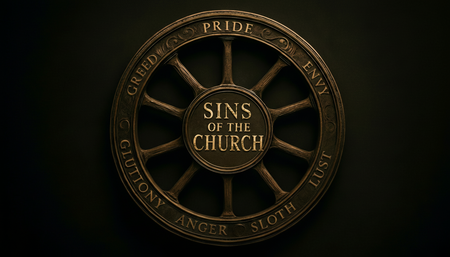
As the New Year begins we now enter into a new sermon series on the church. We’ve done this in many ways over the years. We’ve looked at the nature of the Church, the doctrine of the Church, the marks of the Church, the mission of the Church, and more. This year we turn toward a theme that is sobering, weighty, and necessary. This year we’re going look at the sins of the Church. Why take time to study the sins of the church? To see our sin as it is, in its dreadful and vile nature, and be moved and made more eager to turn away from sin toward Christ.
So for the next two months, we’ll take a cue from Church history. Christians have always been a people who speak of sin, but in the the 4th or 5th century Christians began to categorize seven particular sins as chief sins from which all other sin flows. These seven sins eventually became known as the ‘Seven Deadly Sins.’ They include pride, greed, anger, envy, sloth, gluttony, and lust. Certainly there are more sins than these seven, but there is not a sin that does not originate in one of these seven.
Up first is the sin of pride.
In discussing pride, C.S. Lewis said this in his book Mere Christianity, “There is one vice of which no man in the world is free; which everyone in the world loathes when he sees it in someone else; and of which hardly any people, except Christians, ever imagine that they are guilty themselves…I do not think I have ever heard anyone who was not a Christian accuse himself of this vice. And at the same time I have very seldom met anyone, who was not a Christian, who showed the slightest mercy to it in others. There is no fault which makes a man more unpopular, and no fault which we are more unconscious of in ourselves. And the more we have it ourselves, the more we dislike it in others. This sin I am referring to is pride…this is the great sin…the complete anti-God state of mind.”[1]
Of all the places we could go to examine pride I want to take you back the Tower of Babel in Genesis 11:1-9. This passage easily divides in two, see first…
The Hubris of Man (v1-4)
“Now the whole earth had one language and the same words. And as people migrated from the east, they found a plain in the land of Shinar and settled there. And they said to one another, “Come, let us make bricks, and burn them thoroughly.” And they had brick for stone, and bitumen for mortar. Then they said, “Come, let us build ourselves a city and a tower with its top in the heavens, and let us make a name for ourselves, lest we be dispersed over the face of the whole earth.”
v1-2 serve as an introduction. What first draws our attention is unity. There was one language among all these peoples and they sought to settle together in the land of Shinar. Unity is a good thing, but let me remind you that unity like this is not a good thing. Why? Because God had commanded the opposite. To Adam and Eve, in Gen. 1:28, the command was given to be fruitful and multiply and fill the earth with the image of God. That command is repeated after the flood to Noah and his sons, in Gen. 9:1, to be fruitful and multiply and fill the earth. The idea is that man is to spread out to the ends of the earth. This, they didn’t want to do. Instead, they sought to establish a single, great, unified city. So, from the beginning of this passage, we have a hunch that this isn’t going to end well.
Notice also these peoples migrated from the east. It might seem like a small detail, but eastward movement occurs frequently in Genesis and rarely is it good. Adam and Eve were banished out of Eden to the east. After killing his brother Abel, Cain went off to the East, away from the presence of the Lord. Abraham and Lot separates and Lot chose to go East, ending up in Sodom and Gomorrah. When we read in v2 of this large group heading east, we’re meant to understand this as a bad thing, as a move away from God, and away from the place of His blessing.[2]
In v3-4 all this is confirmed as we hear their intentions. “Come, let us make bricks, and burn them thoroughly … Come, let us build ourselves a city and a tower with its top in the heavens, and let us make a name for ourselves, lest we be dispersed over the face of the whole earth.” The desire here is to build a city, and build a high tower in the middle of it. The technological device they intend to use to accomplish this is the brick. Now, let me be clear. God is not against city building, or skyscrapers, or bricks. God is against the pride of man displayed here.
There are four evidences[3] in the text that show us God’s displeasure in their pride.
First, their desire to build all of this was so that they won’t be dispersed over the whole earth, but since the garden God has commanded men to disperse and spread throughout the whole earth. It’s as if they knew this command of God and in response to it they rebel by gathering in one place to build a great city in defiance of God.
Second, by building they’re sought to make a name and for themselves. Is this a bad thing? After this tower episode we see God Himself promise to work and bless Abraham so that his name is great. What’s the difference between that and this? The difference between all this name making is how the name and renown is achieved.[4] In the tower builders of Gen. 11 we see the name making is a kind of megalomania.[5] But in Gen. 12 it’s not Abraham, but God, who works to make Abraham’s name great. So to seek to make a name for oneself is to declare independence and autonomy from God, the true authority over all.
Third, they intend the tower to have its top in the heavens. That might sound like they just want it to be really tall. But in their day this was temple language, used specifically to speak of entering into the realm of the divine. Which means their intention wasn’t just to build a high tower, but to launch an assault on heaven itself.
Fourth and lastly, there seems to be an intentional echo of the creation account in their own verbiage. They said, “Come, let us make…” just as God said in Genesis 1:26 “Let us make man in our image.” If this is truly part of what’s going on in the building of this tower, it adds more of a rebellious spirit to the builders at Babel.
In summary, what we see here is the pride, or the hubris, of man. The word hubris is an old word, not used much today. In ancient Greek tragedies the word hubris is often used to describe excessive pride aimed in a divine direction. The older King James word vainglory gets at this idea. Here at Babel the hubris of man is displayed in a staggering scope. It shows us that by nature man doesn’t merely reject God, man doesn’t want God to be God. If left to our own devices we would seek to storm heaven, remove God from His throne, and sit down in His place.
This remains true to this day. How so? The spirit of Babel continues in us.[6] We are those who employ our modern technological devices to make a name for ourselves. Our whole culture today impresses upon us that we must use everything and everyone at our disposal to make a name for ourselves, and warns us that failure to do so is to become nameless and unknown in a world of fame and celebrity. Sure, we may not do this with ‘bricks’ like they did but we have bricks of our own making. Chief among our own bricks is our smartphones, which we use to create fake, phony, and beautiful personas of ourselves that must be validated by the court of public opinion seen in likes and follows and views. Everyone must be a content creator, a brand originator, or a YouTube sensation. Or perhaps your Babel-ish spirit takes the form of a contrarian. Where you take pride in not bowing the knee to the smartphone and not taking part in the technological tenor of the present age, and because you don’t give room to this you see yourself as superior to all others around you.
This is the rise and triumph of the modern self. Each and every single one of us is aiming to be our own Babel that’s taller than all the other towers around us. While the vast majority are running fast in this direction, it’s the Christian who ought to be a disruptive witness by living a different kind of life. While the whole world is using and employing modern technological savvy to make their own name known by building communities around themselves, it’s the Christian who ought to use these modern technological means to make much of Christ. It’s the Christian who ought to live in the true community of the Church where we esteem others over ourselves. In a world full of Babel’s, where pride is the chief value, the glory of the Church is humility. Or we could say: when so many are trapped in the aims and goals of the modern Babel like pursuits…knowing Christ, being known by Christ, and making Christ known is what we’re called to do. The proud Spirit of Babel is what we must repent of and the humble Spirit of Christ is what we must pursue.
See secondly…
The Humbling of God (v5-9)
“And the LORD came down to see the city and the tower, which the children of man had built. And the LORD said, “Behold, they are one people, and they have all one language, and this is only the beginning of what they will do. And nothing that they propose to do will now be impossible for them. Come, let us go down and there confuse their language, so that they may not understand one another’s speech.” So the LORD dispersed them from there over the face of all the earth, and they left off building the city. Therefore its name was called Babel, because there the LORD confused the language of all the earth. And from there the LORD dispersed them over the face of all the earth.”
In a sarcastic irony in v5 God mentions He had to come down to see the tower.[7] Remember, God is God. God is not in need of a repositioning to see the tower, He saw it fine where He was.[8] But He says this in v5 to draw attention to how high and holy He is in contrast to how depraved and deluded these builders are. In v6-7 we see God express an honesty, that this is only the beginning of what man will attempt to do if they remain united in their sin. So God comes down and confuses their language. In doing this God isn’t seeking to keep mankind divided and dumb, no. By doing this God, in great mercy, is limiting the damage man can do to themselves.[9] God once again uses verbiage He’s used before in v7, “Come, let us go down…” This not only mocks their intentions in v3-4, but it brings us back to His own words in Genesis 1.
And v8-9 show us the end of the matter. God brings confusion to their language so they could no longer understand one another. This ends the construction of the tower, resulting in their dispersal over all the earth. Ironically the name they desired to achieve was accomplished. But it wasn’t a name they would be pleased with, not at all. They would forever be underneath the banner of the name Babel, the Hebrew word meaning confusion.
Church, here we have witnessed two things. First, we have seen the great sin of pride. And second, we have seen how God humbles those who are proud.
But know this, Babel is not an isolated event. This passage before us is only nine verses, but it casts a long shadow over the rest of the Bible .[10] The pride of man would continue to be displayed to such a degree that God scattered and dispersed His own people among the nations.[11] And scattered and dispersed they would remain, until they day when God Himself would come in Christ to unite them anew.
So in Christ Babel is reversed. In Babel God scattered man out to all the nations, but now in Christ God is drawing all nations to Himself. In Babel man sought to make a name for himself, but now all who come to Christ find in themselves a deeper, truer, and richer desire to make much of the name of Christ. And at Babel God frustrated the building of the city of man, in the end only the city who’s Maker and Builder is God will stand forever. Praise God, the confusion at Babel isn’t the final word for fallen man!
Conclusion:
So, question. Are you a proud person? Do you believe you’re the smartest person in every room you walk into? Do you dislike others when they are the center of attention? Do you view others as merely supporting actors to yourself? Or, if you’ve been hearing this message and can only think of someone else who needs to hear this, you’re a proud person. Be sure of this. The moment you feel yourself thinking that you are better than anyone else, you are being acted upon, not by God, but the Devil.[12]
Maybe pride[13] in you is overt, showing itself in outward, loud and boastful ways. That’s probably the most common way we view and recognize pride. But while this kind of overt pride seeks to establish superiority and demand attention and admiration, there is a quieter pride, a covert pride, that seeks to establish recognition and prominence through suffering and sympathy. When you fail to achieve attention or status, this quieter pride often spirals downward into self-pity, where you embrace a victim mindset believing you are the ‘most wronged’ or have the ‘most unique suffering’ of anyone. Both overt pride that seeks to be the most important and covert pride that seeks to be the most tragic come from indulging in your own ego.
What eventually happens if you give room to pride in any of these ways? You isolate yourself, ensuring a future of disappointed discontentment.
What is the remedy to pride? Humility. A hint of humility in our fallen world is like a drop of cold water in the desert. Church, humility is as wonderful as pride is nasty, and the good news is that humility isn’t difficult to define. Humility is not thinking less of yourself but thinking of yourself less. As pride leads to and thrives in isolation, humility leads to and thrives in community.[14]
Who do we look to for an example of humility? No surprise, we look to Christ. Paul beautifully describes this in Phil. 2, where he says, “Do nothing from selfish ambition or conceit, but in humility count others more significant than yourselves. Let each of you look not only to his own interests, but also to the interests of others. Have this mind among yourselves, which is yours in Christ Jesus, who, though he was in the form of God, did not count equality with God a thing to be grasped, but emptied himself, by taking the form of a servant, being born in the likeness of men. And being found in human form, he humbled himself by becoming obedient to the point of death, even death on a cross.”
Jesus is the only One who could insist on His own rights who could truly have His own way. But in coming to save us, He laid aside His privileges. In humility He condescended, in humility He stooped down, to bring us up to Himself. This means that Christ’s humility not only paved the way for our redemption, but that Christ’s humility is the example, the pattern, and the model for our lives. How do we learn to combat overt pride and seeking superiority and attention? By looking to Christ! How do we learn to combat covert pride and embracing the victim mindset of self-pity? By looking to Christ! How do we combat our innate bent to please ourselves and put our needs before others? By looking to Christ! Beholding the beauty of His humility is the beginning of our own.
Church, isn’t this the life you want to live? Then by God’s grace pursue it! Pride is our natural state, only by grace can we begin to recover. May His grace abound in us.
[1] C.S. Lewis, Mere Christianity (New York, NY: Harper Collins, 1980) 121.
[2] Kenneth A. Mathews, Genesis 1-11:26, NAC (Nashville, Tennessee: B&H, 1996), 478. Contra Boice, 421.
[3] Christopher Watkin, Biblical Critical Theory (Grand Rapids, MI: Zondervan Academic, 2022) 207-209. Watkin lists five, but only four are needed for this context. The absent item is too philosophical for the pulpit.
[4] Mathews, Genesis 1-11:26, 482.
[5] Victor P. Hamilton, Genesis 1-17, NICOT (Grand Rapids, Michigan: Eerdmans, 1990), 353.
[6] Watkin, Biblical Critical Theory, 212-218.
[7] Contra Hamilton, 354.
[8] Watkin, Biblical Critical Theory, 209.
[9] Ibid., 209-210.
[10] Watkin, 211.
[11] Mathews, Genesis 1-11:26, 486.
[12] Lewis, 124-125.
[13] This distinction between overt and covert pride is from a conversation I had with David Brotnov. Insightful indeed.
[14] Dustin Messer, The Death of the Deadly Sins: Embracing the Virtues that Transform Lives, ed. Daniel M. Doriani (Phillipsburg, NJ: P&R, 2025) 53.